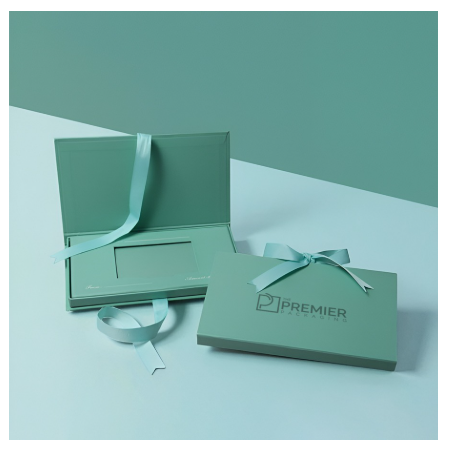
Once upon a time, a gift card was just a piece of paper. You purchased it, put it in an envelope, and that was it. It didn’t matter that much because the gift card mattered. But then something changed. Their expectations were raised. The envelope was cheap. The experience felt rushed. And companies discovered that even a gift card, perhaps particularly a gift card, is worth savoring. Now, the gift card box has had a makeover. In 2026, it is a place of sustainability, luxury, and design. Let’s take a journey back to how this came about and where we’re headed.
The Humble Beginning
Rewind fifteen years. Gift card packaging was purely functional. A simple cardboard sleeve with a cut-out to display the card. Possibly with a bit of foil if the retailer was fancy. The packaging was designed to keep the card safe during transport and to display it on a checkout stand. Nothing more
The thing was, gift cards have an image problem. They were uninspired and a fallback when you could not think of anything else. The card’s look, in its cheap plastic sleeve, conveyed this. The packaging screamed, “I haven’t given this much consideration,” even if the gift giver really meant well. Companies caught on to this. To make a gift card stand out from products, the packaging had to be more emotional. An envelope was just not going to do it anymore.
The Rigid Gift Card Box
The first big change was in the packaging. Companies began packaging gift cards in setup boxes – like those used for watches and jewelry. These boxes had weight. They had magnetic closures. They were difficult to open, and the recipient had to put some effort into discovering the contents.
Why does this matter? Because unboxing was part of the present. A gift card in a hard box is deliberate. It says the person giving the card chose it because it was the best for the recipient, not because it was easier. The package itself is meaningful.
The practice was rapidly taken up by retailers for premium gift cards. A US$200 gift card for a restaurant in a paper sleeve? In a satin-lined hard box with a ribbon tie? That was an experience. And consumers responded. They began taking unboxing shots. They reused them to store things. The packaging was no longer disposable.
The Sustainability Reckoning
But there was a problem. Those nice, rigid boxes came at a cost. Virgin paperboard. Plastic foam inserts. Recycling-hampering magnetic closures. In 2024, customers began to question. Surely there’s a better way to wrap a product that’s already low-waste in packaging that will be in landfill for centuries?
In 2026, sustainability is the norm. It is the standard. More than 78% of consumers report considering the environmental impact of the products they buy. Companies that don’t take this into account do so at their peril.
Future of the Gift Card Box in 2016 and Beyond
Here is what has changed. Gift card boxes in 2026 look like they are made from the finest, highest quality materials, but they are not. The rigid board is now 80-100% post-consumer recycled fiber. The foam inserts have disappeared and been replaced by molded paper pulp, mushroom or sugarcane fiber-based inserts. Magnetic closures are disappearing and being replaced by mechanical ones, including a recently launched click closure made entirely from FSC-certified paperboard that offers the same satisfying click without compromising recyclability.
The packaging has even changed its appearance. In 2025 and 2026, opulent packaging has shifted from foils and plastics to natural textures that convey sustainability. Kraft finishes. Uncoated papers. Light embossing made possible by the micro-embossing technique on recycled paper with an accuracy of 0.1 millimeters and without chemicals. The packaging is sustainable, and it looks sustainable, and that itself is a luxury.
The Experience Layer
One of the most exciting aspects of 2026 is that sustainability hasn’t taken away from the luxury experience. It has enhanced it.
Consider the new gift card boxes. The box may be made from recycled kraft paper, but the linings are made from seed paper. Once the gift card is unwrapped, the recipient can plant the box to grow wildflowers. The box becomes another present. Trash becomes green.
Or think of the smart element. There are now gift card boxes with NFC chips embedded in recycled paper packaging. There are no lights or windows. But when the consumer touches the box with their mobile device, they are rewarded with a customized video greeting from the giver, an authenticity stamp, or even a branded digital experience. Smart packaging provides experiential value to luxury consumers, and 42% are willing to pay a premium.
Then, there are the design innovations of foldable products. A recently launched design for Paris Packaging Week unfolds from a flat, transportable design into an inflexible gift card box within moments.
Final Words
The gift card box has evolved from the paper sleeve. By 2026, it is so much more. It protects the card. It enhances the giving experience. It makes a statement about the brand. It prevents ending up in landfill, either by being compostable, plantable, or a keepsake box.
So, for brands, the challenge is this. People no longer want to choose between indulgence and conscience. They demand both. And the companies that will win will be those that prioritize mono-material packaging, certified recycled content, and new closures without magnets and plastics. They will communicate the product’s sustainability aspects through packaging, with QR codes that lead to digital product passports that reveal the source of all materials and the production carbon footprint.